ADHD Digital Planner Canva KDP: A Practical Workflow Tool for Focus, Consistency, and Real-World Execution
For adults managing ADHD—especially professionals, educators, freelancers, entrepreneurs, and creators—planning isn’t about perfection. It’s about building repeatable, low-friction systems that reduce decision fatigue, anchor attention, and support follow-through. The ADHD Digital Planner Canva KDP is designed for exactly that: a ready-to-deploy, editable digital planning system built not as a static PDF journal, but as a functional workflow asset—tested, structured, and optimized for real use across daily, weekly, and long-term goals.
This isn’t a generic planner repackaged with “ADHD-friendly” in the title. It’s a purpose-built interior file set tested on Amazon KDP, formatted to Kindle Direct Publishing specifications—including bleed—and delivered as a complete production-ready package. That means no last-minute resizing, no guessing at margins, and no reformatting before upload. You get what you need to move from idea to published interior in hours—not days.
How It Fits Into Your Planning Ecosystem
The ADHD Digital Planner Canva KDP works best when treated as a modular component—not a standalone solution. Think of it as the operational layer between your high-level goals and your day-to-day execution. For example:
- A freelance designer uses the Daily Plan and Weekly Summary pages to block time around energy peaks, then exports completed weekly reviews to Notion for client reporting.
- An educator preparing lesson plans pulls the School Timetable and Habit Tracker into Canva, customizes colors and labels, then prints weekly copies for classroom use while keeping the master editable file intact.
- A small business owner integrates the Monthly Budget and Financial Goals sections into their existing QuickBooks workflow—using the planner to draft projections and track assumptions before entering numbers into accounting software.
Its value increases when used alongside tools you already rely on: Google Calendar for scheduling, Trello or ClickUp for task delegation, Obsidian or Evernote for note capture, and even physical whiteboards for brainstorming. The planner doesn’t replace those—it gives structure to the parts they don’t handle well: habit consistency, emotional check-ins, password tracking, self-care intentionality, and visual progress mapping.
What’s Included—and Why Each Element Matters
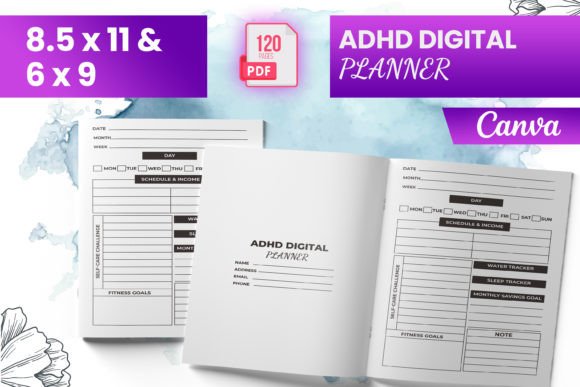
The package delivers 120 total pages, all pre-formatted for professional output. Here’s how each piece serves a practical function:
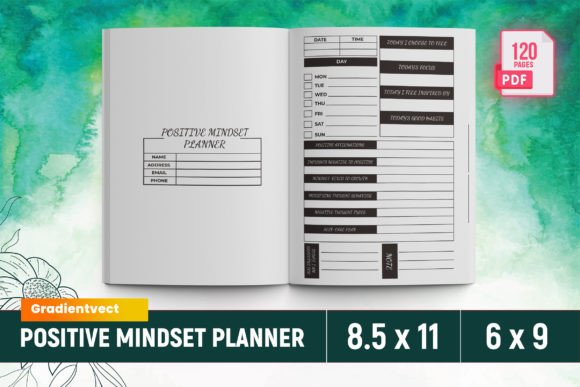
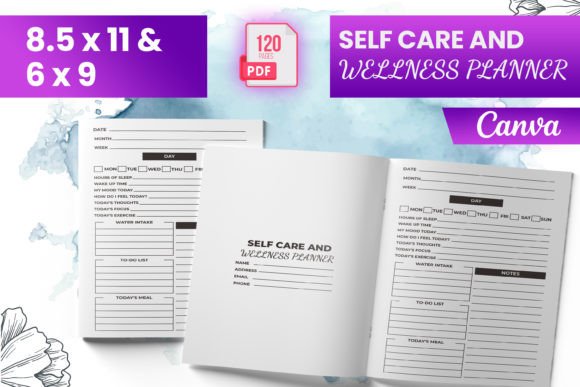
- Ready-to-upload PDF file: Eliminates formatting risk. No need to troubleshoot KDP warnings about margins or bleed. Tested against current KDP requirements (including 0.125" bleed and 8.5" × 11" / 6" × 9" options).
- Multiple size variants (6", 9", 8.5", 11"): Lets you publish across formats without redesigning. A 6" × 9" version works for portable reading; 8.5" × 11" supports detailed budgeting or handwriting clarity.
- Intro page + section dividers: Provides immediate orientation—critical for neurodivergent users who benefit from clear visual hierarchy and predictable navigation.
- PNG and JPG source files: Enables quick edits in Canva—swap fonts, adjust color contrast, add brand elements, or simplify layouts based on personal sensory preferences.
Sections like Contact Password Tracker, Self-Care Planner, and 30 Days Challenge aren’t decorative. They respond to documented ADHD pain points: working memory gaps, emotional regulation strain, and difficulty sustaining motivation across unstructured timeframes. The Home Planner and Extra Information pages allow customization for caregiving, shared household logistics, or medical tracking—making it adaptable beyond solo use.
Using It Before, During, and After Key Activities
Planning support isn’t just for Monday mornings. How you engage with the ADHD Digital Planner Canva KDP shifts depending on context:
- Before a project: Use the Goal Planner and Daily Plan to define success metrics, break scope into micro-tasks, and schedule first actions—even if only two. This reduces the activation energy required to begin.
- During execution: Rely on the Today’s Plan and Habit Tracker to maintain momentum. The timed blocks and visual checkboxes serve as external cues—reducing reliance on internal reminders that often fade mid-task.
- After completion: Leverage the Weekly Summary and Monthly Budget to reflect objectively—not just on outcomes, but on process fidelity. Did energy levels match expectations? Were interruptions predictable or avoidable? That data informs next-cycle adjustments.
This cyclical use builds consistency without demanding rigidity. You’re not locked into one method—you’re equipped to pivot based on what’s working *now*, not what worked for someone else six months ago.
Integration Tips for Long-Term Usability
For sustained value, treat the ADHD Digital Planner Canva KDP like any other tool: calibrate it, protect its integrity, and prune what doesn’t serve you.
Start by auditing which sections land. Try using just three for two weeks—Daily Plan, Habit Tracker, and Self-Care Planner. Notice where friction appears: Is handwriting too slow? Switch to typing in PDF mode. Does visual clutter distract? Hide unused pages in your PDF viewer or delete them from your working copy. Canva editing makes this effortless.
Compatibility matters. If you use an iPad with Apple Pencil, test the PDF on GoodNotes or Notability—ensure text boxes are responsive and ink pressure behaves predictably. If printing, confirm bleed areas won’t cut off key content (the included JPG/PNG files let you preview safely). And always keep a backup of your edited Canva file—separate from your final KDP PDF—so updates stay version-controlled.
Long-term use depends less on filling every page and more on recognizing patterns: When do you consistently skip the Weekly Summary? What triggers abandonment of the 30 Days Challenge? That feedback isn’t failure—it’s data. Use it to simplify, automate, or delegate parts of the system. Maybe the Password Tracker moves to 1Password, freeing mental space for the Financial Goals section instead.
Real Workflow Outcomes—Not Just Features
What changes when this planner becomes part of your routine?
- Faster onboarding for new projects: Clear templates mean less time designing structure and more time doing work.
- Reduced cognitive load during transitions: Moving from “I should plan” to “Here’s where I start” cuts hesitation.
- Better boundary-setting: The Self-Care Planner and Home Planner make non-negotiables visible—not abstract ideals.
- Stronger accountability loops: Weekly summaries surface mismatches between intention and action, enabling course correction—not self-critique.
It won’t eliminate executive function challenges—but it does compress the gap between intention and implementation. And for adults navigating complex roles, that compression is where real progress lives.
If your current system feels fragmented, reactive, or exhausting to maintain, the ADHD Digital Planner Canva KDP offers a grounded alternative: one that respects neurodiversity, honors real-world constraints, and prioritizes usability over aesthetics alone.