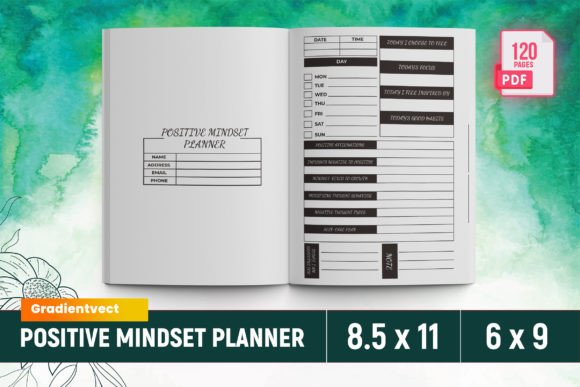
Why the KDP Positive Mindset Planner Canva Is Reshaping How Creators Build Purpose-Driven Digital Products
In today’s fast-paced creative economy, professionals—whether entrepreneurs launching their first digital product, freelance designers scaling passive income, or wellness marketers building authority—are no longer just selling tools. They’re delivering experiences rooted in intentionality, psychological safety, and measurable self-development. At the center of this shift is the KDP Positive Mindset Planner Canva: not merely another printable planner, but a strategically engineered, bleed-ready interior template built for Amazon Kindle Direct Publishing (KDP) that merges behavioral science with scalable digital product design.
A Template Engineered for Impact—Not Just Aesthetics
The KDP Positive Mindset Planner Canva stands apart because it bridges two critical gaps: the technical precision required by Amazon KDP and the human-centered depth expected by today’s conscious consumers. Unlike generic Canva templates or DIY PDFs scraped from free resources, this planner was developed with deliberate structural intelligence. Its 120-page interior includes purpose-built sections—Habit Tracker, Morning Mindset, Limiting Beliefs, Actions By Feelings, and Change Perspectives—each grounded in evidence-informed frameworks like cognitive behavioral techniques, positive psychology interventions, and habit formation theory.
What makes it operationally exceptional is its production-readiness: a tested, bleed-enabled PDF file formatted precisely to KDP’s 6”×9”, 7”×10”, and 8.5”×11” specifications; optional PNG and JPG source files for customization; and an intro page designed to establish tone and trust before the first journal prompt. Every element—from margin allowances to font embedding and CMYK-safe color handling—was validated on live KDP uploads. That means creators skip weeks of troubleshooting, version testing, and rejection loops. Instead, they move straight from concept to published listing—with confidence in print fidelity and user experience.
Aligning With Macro Trends in Creator Commerce and Mental Wellness
This isn’t happenstance. The rise of the KDP Positive Mindset Planner Canva reflects deeper, accelerating shifts across multiple domains:
- The Professionalization of Self-Care: Freelancers, solopreneurs, and remote workers increasingly treat mindset maintenance as non-negotiable infrastructure—not optional “soft skills.” According to a 2023 McKinsey report, 74% of knowledge workers cite sustained focus and emotional regulation as top barriers to productivity. Planners that go beyond scheduling to scaffold reflection, belief reframing, and values alignment directly address that need.
- The Democratization of High-Fidelity Publishing: Canva has lowered the barrier to professional-grade design—but without KDP-specific optimization, many creators still face costly delays. This template eliminates that friction, empowering non-designers to ship polished, category-competitive interiors in under 48 hours.
- The Shift From Transactional to Transformational Products: Consumers are rejecting one-size-fits-all productivity tools. They’re choosing resources that acknowledge complexity—like pairing a Daily Journal with Thinking Positively prompts or anchoring a Weekly Planner to My Life Desires. The KDP Positive Mindset Planner Canva embeds these connections intentionally, supporting longitudinal growth rather than isolated task completion.
Real-World Relevance: How Professionals Are Using It Today
Consider Maria, a certified life coach launching her first KDP workbook. She used the KDP Positive Mindset Planner Canva as her foundation—not as a static download, but as a customizable framework. She added her signature reflection questions to the Daily Journal section, embedded QR codes linking to guided audio meditations in the Morning Mindset spread, and rebranded the Things That Make Me Happy tracker to align with her niche: “Moments of Creative Flow.” Because the interior was already bleed-optimized and KDP-tested, her book launched in seven days—not seven weeks.
Or take James, a marketing consultant who bundles digital products with his service packages. He repurposed the Habits Behaviors and Actions By Feelings pages into a client-facing “Mindset Alignment Audit”—a tangible takeaway that reinforced his methodology while generating organic social proof. The fact that he could export clean PNG assets meant he adapted layouts seamlessly for Instagram carousels and Notion templates—extending the planner’s utility far beyond print.
Design Intelligence Meets Behavioral Architecture
What distinguishes this planner from competitors isn’t just format—it’s architectural intention. Each section serves a distinct psychological function:
- The Habit Tracker uses progressive streak logic and gentle reset prompts—reducing shame-driven abandonment common in rigid binary trackers.
- The Mood Tracker avoids oversimplification by inviting users to layer emotion labels with contextual notes and energy levels—supporting pattern recognition over time.
- Limiting Beliefs doesn’t just list thoughts; it guides users through identification, evidence examination, and compassionate reframing—mirroring clinical CBT workflows in accessible language.
- Change Perspectives introduces cognitive flexibility exercises, helping users practice mental pivots before high-stakes decisions—a subtle but powerful skill for leaders and creatives alike.
This level of embedded pedagogy transforms the planner from a passive record-keeper into an active developmental partner. And because the interior is delivered as a ready-to-upload PDF—alongside editable Canva layers—the creator retains full control over voice, branding, and iterative improvement. No more outsourcing layout tweaks or paying premium designers for minor updates.
Fulfilling Evolving Expectations in the Creator Ecosystem
Today’s buyers don’t just want functionality—they want integrity. They notice when a planner promises “positive mindset” development but delivers only affirmations without scaffolding. They value transparency about how tools align with real-world challenges: decision fatigue, comparison burnout, identity-based imposter syndrome. The KDP Positive Mindset Planner Canva meets that expectation by making the underlying methodology visible—not through jargon, but through thoughtful sequencing and empathetic phrasing.
Simultaneously, platforms like Amazon KDP continue tightening quality thresholds. Print-on-demand now demands consistency across trim sizes, predictable color rendering, and reliable bleed implementation. Templates that assume “good enough” formatting risk suppression, poor reviews, or lost sales velocity. This planner answers that operational reality head-on—ensuring creators invest time in strategy and messaging, not pixel-perfect preflight checks.
More Than a Download—A Launchpad for Sustainable Creation
When you download the exclusive KDP Positive Mindset Planner Canva template, you’re not acquiring a static file. You’re gaining access to a proven system—one that respects both the rigor of publishing standards and the nuance of human growth. Its 120-page structure isn’t arbitrary; it’s calibrated to support daily engagement without overwhelm, weekly review without rigidity, and monthly reflection without abstraction.
For professionals building personal brands, it accelerates authority positioning: a well-executed planner signals deep understanding of audience pain points—and delivers immediate, tactile value. For marketers, it becomes a lead magnet with lasting utility, not disposable content. For educators and coaches, it serves as a reproducible curriculum backbone—adaptable across cohorts, modalities, and goals.
In an era where attention is scarce and trust is earned incrementally, the most valuable digital products aren’t those that promise speed—but those that honor depth, consistency, and care. The KDP Positive Mindset Planner Canva does exactly that: turning intention into implementation, insight into action, and mindset work into measurable, shareable progress.