Kawaii Plants Coloring Book for Adul V-3
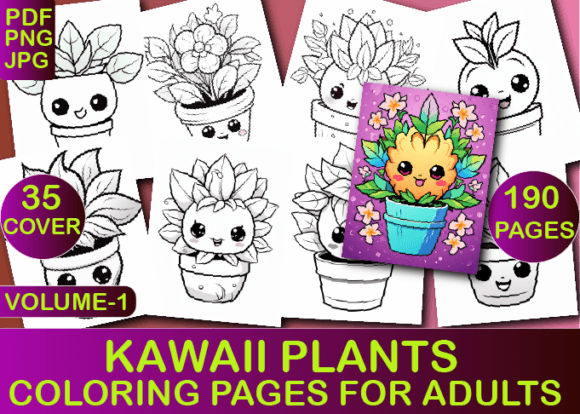
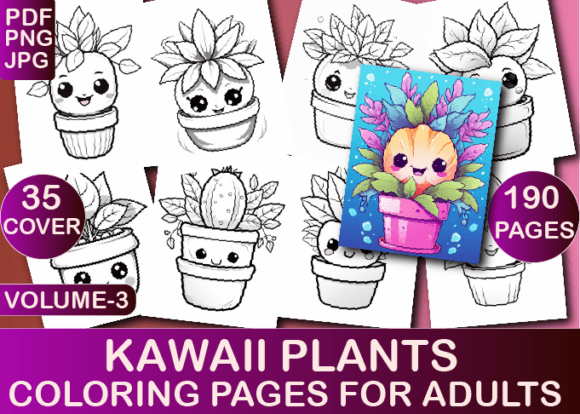
What began as a playful twist on botanical illustration has grown into a quiet movement—gentle, joyful, and deeply intentional. The Kawaii Plants Coloring Book for Adul V-3 is a hand-crafted interior designed specifically for adults who seek calm without cliché, creativity without pressure, and structure without rigidity. It’s not just line art—it’s a toolkit: 190 original black-and-white illustrations of stylized succulents, blooming cacti, leafy monstera vines, and whimsical ferns—all rendered in soft, rounded kawaii aesthetics that invite pause, not perfection.
Why This Interior Fits More Than One Kind of Person
For someone new to coloring—maybe picking up a pencil after years or trying it for the first time—the Kawaii Plants Coloring Book for Adul V-3 offers clarity without complexity. The outlines are clean, the spacing generous, and the plant forms forgiving. There’s no need to “get it right.” A beginner might use it during a 10-minute coffee break, filling one small pot-shaped blossom between emails, noticing how the rhythm of shading slows their breath.
For educators or therapists, the interior serves as a tactile anchor in group settings. One middle-school art teacher uses select pages as low-stakes warm-ups before critique sessions—students choose a kawaii aloe or mushroom fern, color freely, then describe what they noticed about shape, repetition, or balance. No grading. Just presence. The consistent 8.5” x 11” size with bleed means pages scan cleanly for classroom handouts or digital whiteboard projection.
Creatives building digital products—like Canva template designers or Notion planners—often license individual illustrations from the included PNG files. Because each of the 190 images is delivered separately (not just embedded in PDF), they can isolate a single watering can–holding daisy or a smiling potted ivy and drop it into a mood board, social post, or printable habit tracker. No cropping, no background removal, no guesswork.
What Changes Depending on Your Goals
If your priority is flexibility, the file package matters more than the theme. Here, you’re getting both a final print-ready PDF *and* 190 high-resolution PNGs—each at 300 DPI, transparent background, vector-clean edges. That means you’re not locked into coloring alone. You could re-color digitally in Procreate, layer textures in Photoshop, or even convert a few favorites into SVGs for Cricut cutting projects.
If commercial use is part of your workflow—say, you run a small stationery shop or design printable planners—the inclusion of 35 cover backgrounds gives immediate lift. These aren’t generic florals. They’re cohesive, tonally matched to the interior style: soft gradients, subtle leaf motifs, and gentle kawaii framing elements. You can pair one with your own title font and launch a themed product line in under an hour—no design degree required.
For freelancers managing tight deadlines—like a content creator prepping Instagram carousels or a blogger building a lead magnet—the instant digital download removes friction. No waiting for shipping. No physical inventory. You open the folder, pick a page, add your logo or CTA, and export. The black-and-white format ensures crisp results across devices and printers, whether shared via email or printed locally for a workshop handout.
How Quality Shows Up Quietly
You won’t see flashy claims like “best-selling” or “award-winning” here—and that’s intentional. What you *will* notice is consistency: every stem curves with the same gentle confidence; every leaf cluster balances negative space thoughtfully; no two pots look identical, but they all belong in the same garden. That kind of cohesion doesn’t happen by accident. It reflects deliberate pacing—pages alternate between detailed spreads (a full-page bonsai scene with tiny birds) and minimalist single-plant studies (a lone kawaii snake plant centered on white space). That variation supports different moods and energy levels.
The bleed area isn’t decorative—it’s functional. When printed and trimmed, illustrations extend fully to the edge, eliminating awkward white borders that disrupt immersion. And because the PDF is final (not layered or editable), it opens reliably across devices—no missing fonts, no broken links, no version conflicts. For someone printing batches for a community center or therapy practice, reliability isn’t a bonus—it’s non-negotiable.
Who Might Pause Before Downloading
This interior isn’t built for photorealism lovers or those seeking ultra-dense mandalas. If intricate symmetry or architectural line work is your anchor, the kawaii style—soft, simplified, emotionally expressive—may feel too light at first glance. Likewise, if you need editable layers (e.g., separate line art and shadow layers), this package delivers finished assets—not working files. That’s a trade-off, not a flaw: it prioritizes speed and usability over granular control.
Also worth noting: while the 190 illustrations offer variety, they’re intentionally focused on plants—not animals, people, or abstract patterns. That narrow scope is a strength for thematic consistency but may not suit creators building broad asset libraries.
A Few Real Moments of Use
- A freelance marketer used three kawaii plant pages to create branded “growth mindset” visuals for a client’s internal newsletter—pairing a sprouting seedling with short reflection prompts.
- A retired botany professor prints select pages at 150% scale, colors them with watercolor pencils, and gifts them to grandchildren—adding handwritten fun facts about each plant species in the margins.
- A small yoga studio owner laminated six pages and placed them at the entrance as “mindful entry activities”—guests color while waiting, then take their creation home. No instructions needed. Just quiet focus.
The Kawaii Plants Coloring Book for Adul V-3 doesn’t ask you to become an artist. It asks you to return—to attention, to play, to the quiet satisfaction of filling a shape with color and meaning. Whether you’re using it solo at midnight, sharing it in a group setting, or building something new from its parts, the interior meets you where you are. Not as a product to consume—but as material to move through, adapt, and make your own.