Hug Coloring Pages for Kids: A Practical Guide for High-Content KDP Publishers
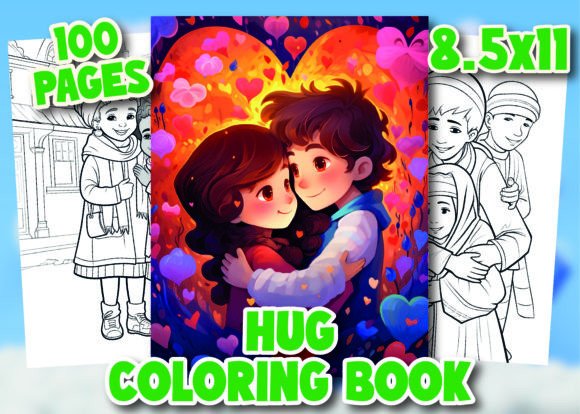
For creators building high-content books on Amazon Kindle Direct Publishing, Hug Coloring Pages for Kids represents a focused, execution-ready interior solution—designed specifically for the coloring book niche with commercial viability in mind. Unlike generic clipart bundles or broad-themed collections, this resource centers on a single, emotionally resonant concept: hugging. Each of the 100 pages features a distinct child character engaged in a hug—whether with a parent, sibling, pet, friend, or even an imaginary creature—rendered in clean, bold outlines suitable for young hands and varied skill levels.
What Sets This Interior Apart from Other Coloring Book Resources
The distinction lies not just in theme, but in structural consistency and publishing readiness. Many public-domain or royalty-free coloring page sets offer uneven line weights, inconsistent sizing, or lack of spacing for binding margins—issues that trigger Amazon KDP rejections or result in poor print quality. In contrast, Hug Coloring Pages for Kids delivers every page at precisely 8.5″ x 11″, with 0.25″ bleed and centered artwork optimized for standard trim size. There are no repeated designs, no overlapping elements near edges, and no grayscale shading that could misprint as solid black. The line art is intentionally medium-weight (1.5–2 pt), balancing clarity for early writers and enough detail to engage older children.
This isn’t a grab-bag of unrelated illustrations. It’s a curated sequence: pages progress subtly in complexity—from simple front-facing hugs with minimal background elements to more dynamic poses (spinning hugs, kneeling hugs, hugs with props like balloons or backpacks). That progression supports developmental appropriateness across ages 3–9, a range often underserved by one-size-fits-all interiors.
Comparing Formats: Why the Included File Types Matter
What makes Hug Coloring Pages for Kids functionally different from many downloadable coloring assets is its multi-format delivery—and the purpose each serves in your workflow:
- PNG files: Transparent-background, high-resolution (300 DPI) raster images. Ideal for quick layout in Canva or Adobe Express when speed matters—but less flexible for editing line weight or scaling without pixelation.
- JPG files: Also 300 DPI, but with white backgrounds. Useful for preview thumbnails, social media teasers, or platforms that don’t support transparency—but not recommended for final print interiors due to potential compression artifacts.
- PDF file: Print-ready, single-page-per-sheet, CMYK-safe, with embedded fonts (where applicable) and proper bleed. This is what you upload directly to KDP after adding your cover.
- AI source file: Fully layered, vector-based (Adobe Illustrator CC 2021+ compatible). Lets you adjust stroke width, recolor elements, add custom text, or rearrange compositions—critical if you plan to build companion titles (e.g., “Hugs Around the World” or “Hug & Trace” variants).
Not all KDP-focused coloring resources include editable vector sources. Some offer only PNGs, limiting customization; others provide low-DPI JPGs unsuitable for print. The inclusion of AI here reflects an understanding of how working publishers iterate—not just launch once, but test variations, refine themes, and expand series based on real sales data.
Fitness for Purpose: When This Interior Fits—and When It Doesn’t
Hug Coloring Pages for Kids excels in scenarios where emotional resonance, thematic cohesion, and production efficiency converge. For example:
- You’re launching a first coloring book and want to minimize formatting risk—no resizing, no alignment fixes, no last-minute bleed corrections.
- Your target audience includes parents seeking gentle, inclusive, non-gendered imagery—every child is drawn neutrally, with diverse skin tones, hair textures, and clothing styles represented across the 100 pages.
- You’re building a seasonal or therapeutic sub-niche: “Back-to-School Hugs,” “Goodbye Hugs for Preschool Graduation,” or “Hugs for Big Feelings”—all of which can reuse the core art with minor text overlays.
However, it may be less suitable if you need:
- Thematic expansion beyond interpersonal connection: There are no holiday motifs, animals-only scenes, or fantasy settings—just children hugging. If your brand leans into dinosaurs, space, or fairy tales, this interior won’t stretch to accommodate those without significant redesign.
- Advanced educational scaffolding: While developmentally appropriate, these pages don’t embed tracing guides, number sequences, or letter practice zones—features found in some “learn-and-color” hybrids.
- Multilingual or bilingual layouts: All pages are image-only. You’d need to add translated captions yourself using the AI file or external design tools.
Real-World Publishing Considerations
Because Hug Coloring Pages for Kids was tested on KDP before release, it accounts for platform-specific constraints most free or third-party assets overlook. For instance:
- All pages meet KDP’s minimum 0.125″ margin requirement—even with arms extended outward, no critical lines fall within the “no-print zone.”
- No pages use RGB-only colors that would shift unpredictably in CMYK conversion; the line art is pure black (#000000), ensuring crisp output on both white and cream paper stocks.
- The file naming convention (
hug_001.png,hug_002.png, etc.) aligns with KDP’s bulk upload expectations, reducing manual reordering during interior assembly.
That level of platform awareness reduces friction—not just for first-time publishers, but for those managing multiple live titles. Time saved on troubleshooting means more time spent analyzing reviews, refining keywords, or planning sequels.
Building Beyond the Base: Customization Without Compromise
The AI source file unlocks practical flexibility without sacrificing quality. You can:
- Add subtle background elements (a sun, clouds, or a simple rug pattern) to unify pages without cluttering the central action.
- Create alternate versions—e.g., “Hug with Speech Bubble” pages—for a companion journal or activity extension.
- Adjust proportions for different age groups: enlarge hands and simplify facial features for toddler-focused editions; add light texture or pattern fills for older kids who prefer more visual interest.
Crucially, none of these edits require redrawing from scratch. Because the base vectors are clean and logically grouped (e.g., “child_body,” “arm_left,” “background_sky”), changes stay scalable and maintain print fidelity. That’s markedly different from editing flattened PNGs, where zooming in reveals jagged edges or unintended transparency gaps.
Final Evaluation: A Balanced Fit for Targeted Goals
Hug Coloring Pages for Kids isn’t a universal solution—but it doesn’t try to be. Its value emerges when matched to clear intentions: launching a cohesive, emotionally grounded coloring book with minimal technical overhead; iterating quickly across related themes; or prioritizing inclusivity and developmental appropriateness over novelty or trend-chasing.
If your goal is rapid testing of market response—say, validating demand for “positive emotion” coloring books before investing in custom illustration—this interior offers a low-risk, high-fidelity starting point. If instead you’re developing a branded series with proprietary characters or cross-promotional tie-ins, you’ll likely need custom art—but even then, the AI file can serve as a stylistic reference or foundation for commissioned work.
Ultimately, the strength of Hug Coloring Pages for Kids lies in its restraint: 100 intentional pages, built for one purpose, delivered in formats that support both immediate use and thoughtful adaptation—all verified against the realities of Amazon KDP’s requirements and buyer expectations.