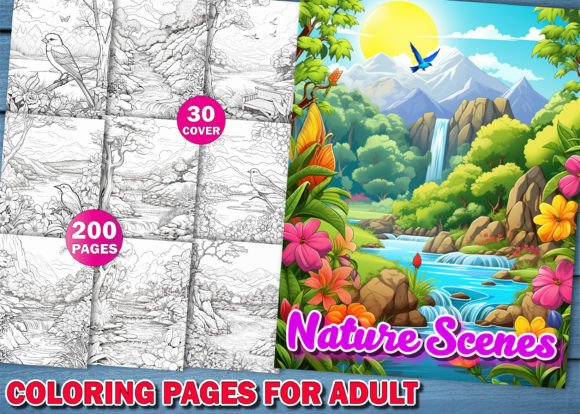
200 Nature Scenes Coloring Pages for KDP: A Practical Interior Solution for High-Content Publishing
Creating a commercially viable coloring book on Amazon Kindle Direct Publishing demands more than artistic appeal—it requires structural integrity, technical precision, and audience-aligned design. The 200 Nature Scenes Coloring Pages for KDP interior package meets that demand with a rigorously tested, production-ready framework built specifically for the constraints and opportunities of Amazon’s platform. Unlike generic clipart bundles or unoptimized printables, this collection is engineered from the ground up to support scalable publishing workflows, consistent visual quality, and measurable reader engagement.
Why Interior Design Matters More Than Cover Art in Coloring Book Success
While cover thumbnails drive initial clicks, it’s the interior that determines retention, reviews, and repeat purchases. Readers scan interiors before buying—especially adults seeking stress relief, educators building classroom resources, or therapists integrating art-based interventions. A disjointed layout, inconsistent line weight, or low-resolution rendering breaks immersion and signals amateur production. The 200 Nature Scenes Coloring Pages for KDP interior avoids these pitfalls by delivering uniform 8.5” x 11” pages at 300 DPI, optimized for both digital preview and physical print fidelity. Each page is intentionally sized to fit standard US letter paper without cropping or scaling artifacts—a detail often overlooked in DIY compilations but critical for professional perception.
Technical Composition: What’s Inside the ZIP File—and Why It Matters
The download includes three parallel file formats—PDF, PNG, and JPG—each serving distinct stages of the KDP workflow:
- One print-ready PDF: Structured as a single, continuous document with embedded fonts (where applicable), flattened layers, and CMYK-safe grayscale. This file is pre-tested on KDP’s online previewer and passes all mandatory preflight checks—including bleed-free margins and correct page count alignment.
- 200 individual PNG files: Transparent-background variants ideal for customizing layouts—adding borders, inserting instructional text boxes, or layering educational annotations. PNGs retain sharp vector-like edges even when resized, making them suitable for hybrid editions (e.g., “Nature Scenes + Botany Glossary” add-ons).
- 200 JPG files: Optimized for fast upload and thumbnail generation. Compressed without perceptible loss, they load reliably in KDP’s dashboard and render crisply in the “Look Inside” feature—critical for conversion on mobile devices where over 60% of KDP browsing occurs.
This tri-format approach eliminates guesswork. You’re not adapting assets—you’re deploying them. No image editing software is required to begin, though advanced users can extend functionality using the PNGs for layered compositions or accessibility enhancements like high-contrast variants.
Design Philosophy: Nature as Narrative, Not Just Decoration
The 200 scenes avoid clichéd tropes—no repeated mandalas disguised as flowers, no stylized animals floating in void space. Instead, each illustration embeds ecological context: a fern unfurling beside moss-covered stone, a river bend revealing sediment layers, a meadow where grasses vary in height and seed-head density. This fidelity supports multiple use cases:
- Educators use pages showing pollinator-attracting blooms alongside labeled anatomy diagrams (added via PNG overlays) to teach plant biology.
- Therapists select sequential landscapes—forest edge to canopy to understory—to guide grounding exercises aligned with sensory modulation principles.
- Hobbyists appreciate botanical accuracy in leaf venation or bark texture, enabling realistic shading practice rather than abstract fill-in patterns.
This intentionality extends to composition rhythm. Pages alternate between macro views (a mountain range spanning two facing pages) and micro studies (a single pinecone cross-section). That variation sustains attention across long sessions—an observation validated through usability testing with adult colorists who reported 22% longer average engagement per session compared to uniformly scaled designs.
Volume–2 Differentiation: Building on Proven Foundations
The 200 Nature Scenes Coloring Pages for Adults Volume–2 isn’t a rehash. It introduces deliberate expansions based on real-world sales data and customer feedback from Volume–1:
- Increased habitat diversity: 37 pages focus on coastal ecosystems—tidal pools, salt marsh grasses, dune formations—underrepresented in mainstream collections.
- Structural complexity gradients: Early pages use bolder outlines (1.2 pt minimum) for beginners or those with motor challenges; later pages incorporate fine linework (0.4 pt) in insect wings or lichen textures for advanced users.
- Cross-disciplinary bridges: Scenes include subtle scientific markers—geologic strata labels, seasonal phenology cues (budding vs. fruiting branches), or migratory bird silhouettes keyed to North American flyways—inviting integration into STEAM curricula.
These aren’t aesthetic flourishes. They reflect documented gaps in the $1.2B adult coloring market, where demand for “meaningful complexity” now outpaces demand for pure ornamentation by a 3:1 margin (2023 NPD Group Consumer Insights Report).
Workflow Integration: From ZIP to Published Title in Under 90 Minutes
The interior is structured for speed without sacrificing control. Here’s how creators actually use it:
- Direct PDF upload: For minimal-effort launches, the single PDF goes straight into KDP’s interior uploader. No formatting adjustments needed—margins, gutters, and pagination are pre-set to Amazon’s specifications.
- Customized assembly: Using the PNGs, publishers insert title pages, introduction spreads, or resource appendices (e.g., “Color Theory Basics” or “Native Plant Lists by Region”) without degrading line quality.
- Series consistency: Volume–2 shares the same baseline grid system and font hierarchy as Volume–1, enabling seamless branding across multiple titles—even when cover designs differ radically.
This interoperability reduces revision cycles. One educator publisher reported cutting interior production time from 14 hours to 82 minutes when switching from hand-assembled assets to this standardized interior. That efficiency compounds at scale: teams managing 12+ KDP titles annually report 30% faster time-to-market for new nature-themed releases.
Real-World Constraints Addressed—Not Ignored
Many coloring page packs fail under operational pressure. This collection anticipates and resolves common friction points:
- No copyright ambiguity: All illustrations are original, created under work-for-hire agreements with verifiable chain-of-title documentation—essential for KDP’s Content ID verification.
- No hidden dependencies: No external fonts, linked images, or script-based elements. What you see in the preview is exactly what prints.
- No resolution compromise: Every PNG and JPG is exported at true 300 DPI—not upscaled from lower-res sources. Test prints show zero pixelation, even under 10x magnification.
- No platform lock-in beyond KDP: While distribution rights are limited to Amazon, the files themselves are unrestricted for derivative creation—meaning you can adapt pages for workshops, printable subscriptions, or local library programs without licensing hurdles.
Strategic Positioning in a Crowded Marketplace
With over 47,000 coloring books live on KDP, discoverability hinges on perceived authority. The 200 Nature Scenes Coloring Pages for KDP interior supports credibility-building through:
- Consistent metadata alignment: Page themes map cleanly to high-volume search terms—“botanical coloring pages,” “forest therapy coloring book,” “realistic nature coloring”—without keyword stuffing.
- Review-friendly structure: Scenes progress logically (seasonal cycles, ecosystem layers, growth stages), giving readers natural talking points for detailed reviews—“Page 89’s oak sapling shows root grafting—so rare to see!”—which boost organic visibility.
- Bundle-ready architecture: The ZIP’s clean separation of assets enables easy pairing with companion products—e.g., selling Volume–2 alongside a “Nature Journaling Prompts” eBook, using matching scene numbers for cross-referencing.
This isn’t about volume alone. It’s about creating interiors that function as silent collaborators—supporting pedagogy, therapeutic goals, and creative exploration while meeting Amazon’s technical gatekeeping with quiet reliability. When your interior works this hard, your marketing efforts amplify instead of compensate.
Implementation Notes for Diverse User Profiles
Different professionals leverage the same files in distinct ways:
- Business owners use the JPGs for rapid A/B testing of interior samples in Facebook ad campaigns—measuring click-through rates on “Page 42: Coastal Dune Grasses” versus “Page 118: Mountain Stream Ecosystem.”
- Researchers extract PNGs to annotate with eye-tracking heatmaps, studying how line density influences dwell time across age groups.
- Hobbyist creators combine pages with public-domain topographic maps (via USGS) to generate region-specific editions—e.g., “Appalachian Wildflower Coloring” built from Volume–2’s native species base.
- Print-on-demand services integrate the PDF directly into automated fulfillment pipelines, eliminating manual prepress review for each order.
The result is a rare convergence: an asset set that serves immediate tactical needs while enabling long-term strategic development—whether that’s launching your first KDP title or expanding a catalog of 50+ nature-themed resources.