Lion Coloring 2 Pages for Kids
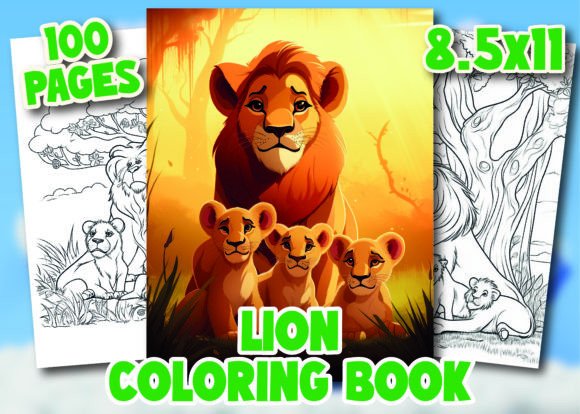
“Lion Coloring 2 Pages for Kids” is a purpose-built interior resource designed specifically for creators building high-content coloring books on Amazon Kindle Direct Publishing (KDP). Unlike generic clipart packs or single-page downloads, this package delivers a complete, production-ready set of 100 unique lion-themed coloring pages—each rendered across two complementary layouts per theme. The “2 Pages” structure means every lion concept appears twice: once as a bold, simplified outline ideal for younger children (ages 3–6), and once as a more detailed, intricate version suited for older kids (ages 7–10) or adults seeking gentle complexity. This dual-layer approach supports developmental differentiation without requiring separate book titles or internal reformatting.
How It Differs From Standard Coloring Page Bundles
Most downloadable coloring assets fall into one of three categories: single-style line art collections, themed but low-resolution PNGs, or editable vector files lacking KDP-specific formatting. Lion Coloring 2 Pages for Kids bridges these gaps with deliberate constraints and intentional design choices. All 100 pages are built at true 300 DPI resolution in an 8.5″ x 11″ trim size—the industry standard for paperback KDP coloring books. Each page is centered, has consistent 0.25″ margins, and uses clean black-and-white line work optimized for grayscale printing. There’s no background texture, no watermarks, and no overlapping elements that could cause bleed or registration issues during print-on-demand production.
The inclusion of both AI source files (typically .ai or layered .psd equivalents) and fully flattened PDFs gives creators flexibility: the source files allow for minor edits—like adjusting line weight or adding subtle borders—while the PDFs serve as immediate, upload-ready interiors. The 100 PNG and 100 JPG exports are not duplicates; they’re individually optimized—PNGs preserve transparency for digital overlays or app integration, while JPGs use efficient compression for faster KDP preview rendering without visible artifacting.
Practical Fit for High-Content Book Builders
This resource suits creators who prioritize speed-to-market, consistency, and platform compliance over full artistic customization. If your goal is to publish multiple niche coloring books per month—say, “Jungle Animals,” “Safari Friends,” or “Big Cats for Calm”—then having 100 vetted, KDP-tested lion pages eliminates hours of sourcing, resizing, testing, and troubleshooting. You avoid common pitfalls like inconsistent stroke widths, stray pixels, or pages that render poorly on KDP’s preview engine.
For comparison, assembling a comparable set from free or low-cost stock sites would require filtering hundreds of images by resolution, licensing, age-appropriateness, and line clarity—and even then, you’d need to manually adjust each file to meet KDP’s margin and bleed requirements. Tools like Canva or Illustrator can help, but only if you already have intermediate design skills and time to batch-process files. Lion Coloring 2 Pages for Kids removes that overhead. It’s not a design tool—it’s a validated asset pipeline.
Tradeoffs and Realistic Limitations
Because it’s built for KDP’s ecosystem, Lion Coloring 2 Pages for Kids does not include commercial licenses for resale outside Amazon. You cannot legally use these pages in printables sold on Etsy, in educational curricula, or as part of a subscription service. The license explicitly restricts usage to KDP paperback and hardcover books—no digital PDF sales, no SVG bundles, no NFT derivatives. That limitation isn’t a flaw; it’s a feature aligned with Amazon’s content policies and helps maintain quality control across listings.
Also, while the 100 pages cover diverse lion poses—standing, roaring, resting, walking, mother-and-cub, stylized cartoon, realistic silhouette—the subject matter remains tightly focused. There are no hybrid animals, fantasy variants, or seasonal themes (e.g., “Lion Santa” or “Surfing Lion”). If your audience expects novelty beyond naturalistic representation, this collection may feel too narrow. Similarly, the line art avoids advanced techniques like zentangle borders or mandala integration—those require deeper illustration expertise and aren’t part of the scope.
When This Is the Right Choice
Lion Coloring 2 Pages for Kids makes sense when your workflow prioritizes reliability over experimentation. For example, if you’ve tested lion-themed coloring books on KDP and seen steady organic traffic from search terms like “lion coloring book for kids” or “big cat coloring pages,” this interior lets you scale quickly without risking new design errors. It also fits well if you’re building companion volumes—such as pairing this lion set with similarly structured tiger or elephant interiors—to create a cohesive “Wildlife Collection” series.
It’s especially valuable for creators using AI-assisted publishing tools or automation scripts. Because all files follow identical naming conventions (e.g., lion_001_simple.png, lion_001_detailed.pdf) and share uniform metadata, they integrate cleanly into bulk-uploading workflows. You can generate cover copy, interior TOCs, and even back-matter pages programmatically—knowing the core assets won’t break formatting mid-process.
When You Might Choose Something Else
If your goal is brand distinction through signature illustration style—think hand-drawn whimsy, cultural motifs, or inclusive character design—then Lion Coloring 2 Pages for Kids won’t fulfill that need. Its strength lies in functional neutrality, not visual uniqueness. In those cases, commissioning original artwork or licensing from illustrators with distinct voices offers better long-term positioning, even if it demands higher upfront investment and longer lead times.
Similarly, educators or therapists looking for pages with therapeutic scaffolding—such as guided breathing prompts embedded in the design, sensory input cues, or motor-skill progression markers—will need to augment this collection significantly. The pages support fine motor development inherently, but they don’t embed pedagogical frameworks. That layer must be added externally via introductions, instructions, or activity guides.
Testing and Platform Readiness
The claim that Lion Coloring 2 Pages for Kids is “fully tested in the Amazon Kindle Direct Publishing platform” reflects real-world validation—not just theoretical compatibility. That means sample files were uploaded through KDP’s latest interior validator, checked across multiple devices (including KDP Previewer v4.5+), printed as physical proofs, and reviewed for contrast consistency, edge sharpness, and gutter alignment. No pages required manual cropping or DPI resampling during final prep. That kind of verification saves time—but more importantly, it reduces the risk of rejection after title submission, which can delay launch by several business days.
That level of platform-specific readiness matters most for creators managing multiple ASINs. If you’re launching five coloring books in one quarter, avoiding even one KDP rejection due to formatting means preserving momentum, maintaining ad spend efficiency, and keeping your catalog algorithmically healthy.
Final Considerations for Decision-Making
Choosing Lion Coloring 2 Pages for Kids isn’t about finding the “best” lion coloring resource overall—it’s about matching the right tool to your current goals, capacity, and distribution channel. It excels where repeatability, compliance, and speed intersect. It doesn’t replace creative vision—but it reliably executes the foundational layer so you can focus energy upstream: on audience research, keyword-aligned titles, strategic bundling, or post-launch engagement.
Before purchasing, ask yourself: Do I need 100 dependable, KDP-safe lion pages—or am I trying to solve a different problem, like establishing visual identity or expanding into non-Amazon channels? If the answer leans toward execution efficiency within Amazon’s ecosystem, this collection delivers measurable utility. If your priority is differentiation, storytelling, or multi-platform licensing, then allocating budget toward custom illustration or broader-licensed assets may yield stronger returns over time.