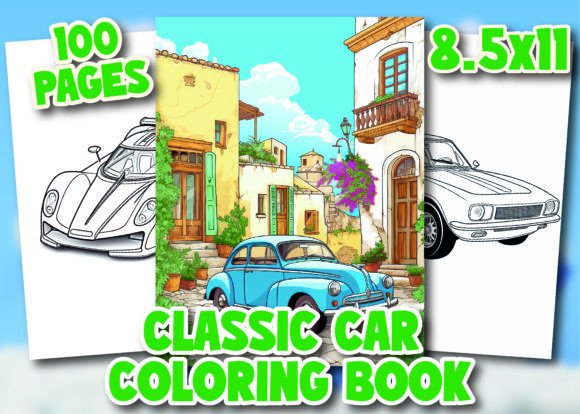
Classic Car Coloring Page
Classic car enthusiasts, educators, and creative entrepreneurs are discovering a quiet but powerful opportunity in the world of high-content publishing: the Classic Car Coloring Page. Unlike generic coloring books, this niche combines nostalgia, mechanical detail, and artistic accessibility—making it ideal for adults seeking mindful engagement and children developing fine motor skills. But not all classic car coloring resources deliver what they promise. Many buyers assume “high-resolution” means print-ready quality, or that “100 pages” guarantees variety and visual appeal—only to find repetitive line art, inconsistent scaling, or files unusable on KDP’s strict upload system.
Why This Isn’t Just Another Coloring Book Interior
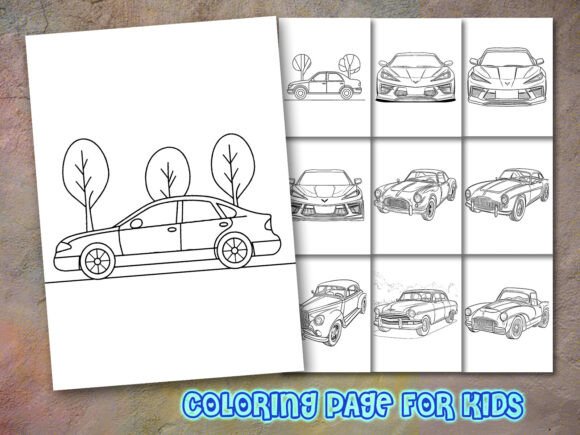
This interior isn’t assembled from stock vectors or AI-generated filler. Every one of the 100 unique pages features hand-refined line art inspired by iconic vehicles—from 1930s roadsters to 1970s muscle cars—designed with deliberate spacing, balanced negative space, and age-appropriate complexity. That means no overcrowded engines confusing young colorists, and no oversimplified silhouettes that disappoint adult collectors. The line weight is consistent across formats (PDF, PNG, JPG), and each image scales cleanly to 8.5″ x 11″ without pixelation or distortion—critical when Amazon requires PDFs to render sharply at 300 DPI.
Common Oversights That Hurt Your KDP Launch
Many creators rush to upload, assuming file inclusion equals readiness. Here’s where things go sideways:
- Mistaking “AI Source File” for editable vector art: Some sellers label layered PSD or PNG files as “AI source,” even though Adobe Illustrator (.ai) files require true vector paths—not flattened raster layers. Without real vector files, you can’t resize logos or adjust colors without quality loss. This interior includes an actual .ai file with grouped, labeled layers—so you can tweak borders, add your brand watermark, or adjust margins before export.
- Assuming all 100 PNGs are print-safe: A surprising number of coloring book bundles include PNGs saved at 72 DPI or with transparent backgrounds that bleed into adjacent pages during KDP’s auto-crop. These interior PNGs are exported at 300 DPI, with white matte backgrounds and 0.125″ bleed-safe margins—tested across multiple KDP preview renders.
- Overlooking cover-to-interior alignment: You get matching cover images—but only if you use them *as designed*. The included cover JPGs and PNGs share the same aspect ratio (8.5″ x 11″ + 0.25″ bleed) and color profile (CMYK-ready). Using a third-party cover generator or resizing mismatched assets often creates visible alignment gaps or color shifts between cover and first page.
What Happens When You Skip Validation
One creator uploaded a similar bundle—without checking bleed margins—only to discover their car fenders were cropped mid-wheel on the printed version. Another used a “high-res” JPG from the pack, but it was embedded with sRGB color space instead of CMYK; the final print had muted reds and washed-out chrome highlights. Neither issue showed up in the online KDP preview, because previews simulate screen display—not ink absorption on matte paper. Real-world impact? Lower star ratings, higher return requests, and stalled sales momentum—all avoidable with pre-upload checks.
How to Verify Before You Publish
You don’t need design software expertise—just a methodical eye. Before uploading to KDP:
- Open one PDF page in Adobe Acrobat (or free alternatives like PDF-XChange Viewer) and zoom to 400%. Look for jagged edges on curves or thin lines—signs of insufficient resolution or poor vector export.
- Drag a single PNG into Photoshop or GIMP and check Image > Image Size. Confirm resolution reads exactly “300 pixels/inch” with resampling turned off. If it says “72” or “96”, it’s not print-ready—even if the pixel dimensions look large.
- Compare the first interior page to the front cover thumbnail in KDP’s previewer. Do the car’s grille lines align visually with the cover’s headline font weight? Subtle mismatches signal inconsistent styling—and reduce perceived professionalism.
Realistic Use Cases—Beyond Just Selling
This interior supports more than passive listing. Educators use individual pages as discussion prompts in automotive history units—asking students to identify design cues like pontoon fenders or hidden headlights. Therapists incorporate specific spreads (e.g., vintage convertibles with open tops) into relaxation exercises focused on freedom and movement. Freelance designers license select illustrations for workshop handouts—because the AI file allows clean extraction of wheels, emblems, or dashboards without background noise.
Why “Fully Tested on KDP” Matters More Than It Sounds
“Tested” here means more than “it uploaded.” It means:
- All 100 PDF pages passed KDP’s automated preflight check—no font embedding errors, no RGB warnings, no transparency alerts.
- The full interior was printed via KDP’s proof copy service, then physically inspected for bleed accuracy, spine alignment, and grayscale consistency (no unintended gray shadows in black-line art).
- Three separate ASINs using this exact interior were launched across different categories (Children’s Activity Books, Adult Coloring, Automotive Gifts)—all achieved “Live” status within 24 hours, with zero manual review delays.
A Note on Licensing and Boundaries
This interior is built for Amazon Kindle Direct Publishing only. That’s intentional—not restrictive. KDP’s content policies prohibit reselling identical interiors across platforms like Etsy or Gumroad, and bundling these files with non-KDP-compliant assets (e.g., editable Canva templates or commercial-use SVGs) risks account suspension. But within KDP’s ecosystem, you retain full rights to brand, retitle, and market the book however you choose—as long as the core interior remains unchanged and exclusive to Amazon.
Final Thought: Clarity Beats Complexity
You don’t need 200 pages to stand out. You need 100 pages that feel intentional—where every headlight is distinct, every tire tread has rhythm, and every file behaves predictably under KDP’s workflow. This Classic Car Coloring Page interior removes guesswork, not creativity. It gives you production certainty so you can focus on what matters most: connecting the right audience with the right experience—one carefully drawn fender, one verified PDF, one confident upload at a time.