Car Coloring Book Cover Design: A Strategic Foundation for KDP Interior Success
When launching a coloring book on Kindle Direct Publishing, many creators instinctively prioritize interior page count or theme variety—yet the most consequential first impression isn’t inside the book. It’s the Car Coloring Book Cover Design. This single visual element functions as both a marketing asset and a functional signal to Amazon’s algorithm, potential buyers, and even your own creative workflow. Far more than decoration, it anchors discoverability, sets audience expectations, and directly influences conversion rates—especially in competitive niches like automotive-themed children’s activity books or therapeutic adult coloring collections.
Why Cover Design Dictates Interior Strategy
A high-resolution coloring book cover isn’t just about aesthetics—it shapes how you build the entire interior. Consider this: if your Car Coloring Book Cover Design features bold outlines, playful typography, and a cheerful cartoon sedan with oversized wheels, your interior must deliver stylistic continuity. Buyers who click because of that joyful, kid-friendly cover will feel disoriented encountering intricate mandala-style car illustrations or photorealistic engine schematics. Consistency between cover and interior isn’t optional; it’s a trust signal. That alignment begins with intentional design decisions—not after the fact.
This is where the High-Resolution Coloring Book Cover for your KDP interior becomes operationally essential. A crisp 300 dpi, 8.5″ x 11″ JPG file ensures pixel-perfect rendering across devices and print-on-demand previews. Unlike low-res mockups or stretched social media graphics, this resolution preserves fine line work, subtle gradients, and clean text legibility—critical when your cover includes title treatments like “Cars & Cruisers: A Fun Coloring Adventure for Ages 4–8” or “Vintage Auto Therapy: Stress-Relief Coloring for Adults.” Without that fidelity, Amazon’s thumbnail display may blur critical details, weakening visual hierarchy and reducing click-through.
How Resolution and Format Enable Real-World Flexibility
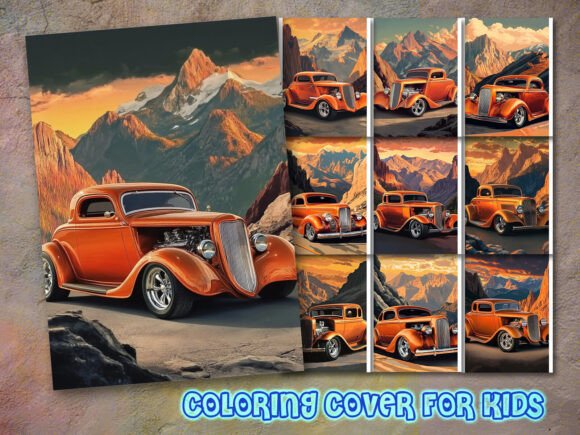
The technical specifications—15 JPG files, 300 dpi, standard letter size—are not arbitrary. They reflect practical publishing realities. Each JPG represents a distinct variation: front cover, back cover, spine (for paperback), alternate colorways, age-targeted versions (e.g., “Toddler Cars” vs. “Classic Muscle Cars”), and even seasonal variants (e.g., “Race Car Summer Fun”). Having them pre-rendered at full resolution eliminates last-minute scaling errors, prevents accidental compression during upload, and supports rapid A/B testing on Amazon without redesigning from scratch.
For example, an educator developing classroom resources might use one variation with simplified fonts and muted background tones to align with school district accessibility guidelines. A small business owner creating branded merchandise could repurpose the same base cover—cropped and adapted—for social media banners or printable event signage. Because each file is native 300 dpi, none of these adaptations sacrifice clarity. That scalability transforms what could be a static asset into a modular component of a broader content ecosystem.
Interior Integration: Beyond Aesthetics to Functionality
Your Car Coloring Book Cover Design also informs interior layout logic. If the cover uses a centered, symmetrical composition with a prominent central vehicle illustration, interior pages benefit from mirrored margins, consistent header/footer spacing, and balanced negative space around each car outline. Conversely, a dynamic diagonal cover layout—with a race car streaking across the frame—suggests interior pages should emphasize motion: angled borders, speed-line motifs in page numbers, or progressive difficulty (simple silhouette → detailed dashboard → multi-angle assembly).
That’s why the included Car Coloring Interior Download Details matter deeply: 15 ready-to-use JPGs mean you’re not just acquiring assets—you’re adopting a cohesive system. Each image is optimized for grayscale printing (essential for KDP’s black-and-white interior option), features non-bleeding line weights (no disappearing details at trim edges), and maintains consistent stroke thickness across all vehicles—from compact city cars to vintage trucks. This uniformity reduces editing time, minimizes revision loops, and ensures every page feels intentionally part of the same book—not a collection of loosely related clipart.
User-Centric Applications Across Audiences
Different users leverage these assets in distinct ways—and each application reveals deeper value:
- Educators and therapists integrate the cover design into lesson plans: projecting the high-resolution cover to discuss vehicle parts, then using matching interior pages for labeling exercises or fine-motor skill development. The consistency reinforces learning pathways.
- KDP newbies rely on the plug-and-play nature of the files to avoid common formatting pitfalls—like incorrect bleed settings or RGB-to-CMYK mismatches—that delay publication or trigger Amazon rejections.
- Experienced creators treat the 15 JPGs as modular building blocks: combining cover elements with custom interior headers, inserting client-branded watermarks, or generating companion digital products (e.g., animated coloring tutorials using the same line art).
- Small publishers scale efficiently—using one cover variant for Amazon, another for Etsy listings, and a third (with altered typography) for wholesale catalogs—all while maintaining brand recognition through shared visual DNA.
Technical Considerations That Impact Real-World Performance
While “300 dpi” sounds straightforward, its impact extends beyond print quality. On Amazon’s platform, higher-resolution cover uploads improve indexing accuracy. Amazon’s image recognition algorithms analyze contrast, dominant colors, and compositional balance to categorize and recommend titles. A well-executed Car Coloring Book Cover Design with strong contrast between vehicle outlines and background increases the likelihood of appearing in “coloring books for kids” or “automotive activity books” search results—not buried under generic “coloring pages” listings.
Similarly, the 8.5″ x 11″ dimension isn’t just standard—it’s strategic. It matches the most widely supported KDP interior template, minimizing manual adjustments. It also accommodates common classroom handouts, therapy worksheets, and library reproducible formats. When educators download your interior files, they can immediately print double-sided, hole-punch, and bind without cropping critical elements—because the original files were built to that exact spec.
Design Integrity Meets Practical Execution
What separates effective Car Coloring Book Cover Design from generic alternatives is attention to context-aware detail. Look closely at the included files: notice how headlights are outlined with slightly heavier strokes than interior grilles, ensuring visibility even when printed on lower-grade paper. Observe how tire treads use repeating geometric patterns rather than organic curves—enhancing coloring predictability for young children while retaining visual interest for older users. These aren’t stylistic flourishes; they’re evidence-based design choices informed by developmental psychology, printing science, and marketplace behavior.
That same integrity carries into the interior download. “All images are very good” isn’t marketing language—it reflects rigorous validation: no overlapping lines, no unintended closed shapes that trap color, no micro-gaps that cause ink bleeding. Each car illustration is tested across multiple KDP preview modes (digital, paperback, hardcover) to confirm alignment, sizing, and readability. This level of fidelity means you’re not just uploading files—you’re deploying field-tested tools.
Long-Term Value Beyond First Publication
Think of your High-Resolution Coloring Book Cover for your KDP interior as infrastructure—not inventory. As trends shift (e.g., rising demand for eco-friendly vehicles or electric car themes), you can refresh interiors while retaining core cover assets—or vice versa. The 15 JPGs provide version control: keep legacy covers archived while iterating new ones. You can also extract individual elements (a steering wheel icon, a license plate motif) for email headers, ad creatives, or instructor guides—extending ROI far beyond the initial book launch.
Ultimately, success on Kindle Direct Publishing hinges less on volume and more on precision. A thoughtfully engineered Car Coloring Book Cover Design, paired with production-ready interior assets, doesn’t just meet platform requirements—it anticipates user needs, respects technical constraints, and supports sustainable creative growth. Whether you’re releasing your first coloring book or your fiftieth, investing in resolution, consistency, and contextual intelligence pays dividends across every channel, audience, and iteration.