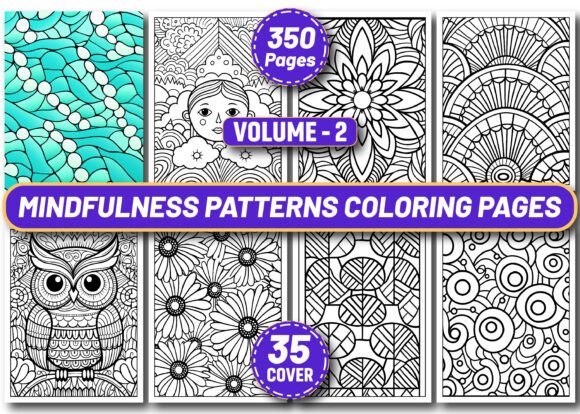
350 Mindfulness Patterns Coloring Pages
Mindfulness isn’t just a practice—it’s a strategic lever. When applied intentionally, it sharpens attention, reduces cognitive load, and creates space for better decisions. The 350 Mindfulness Patterns Coloring Pages is not a novelty product or a passive pastime. It’s a tactile, low-friction tool designed to support sustained mental clarity—especially for adults who operate under constant demand: entrepreneurs launching campaigns, educators designing curricula, freelancers managing overlapping deadlines, marketers analyzing data fatigue, or small business owners balancing operations and growth.
Why This Isn’t Just Another Coloring Book
Most coloring resources treat relaxation as an endpoint. The 350 Mindfulness Patterns Coloring Pages treats it as infrastructure. Each of the 350 original patterns is crafted with rhythmic repetition, balanced negative space, and intentional visual pacing—not for aesthetic novelty alone, but to gently guide attention inward without requiring instruction or interpretation. That matters because intentionality scales: when you choose a tool not for its surface appeal but for its functional alignment with your working rhythm, you invest in outcomes—not just activity.
This interior is built for real-world use. The 300 DPI resolution ensures crisp lines whether printed on office-grade printers or professional presses. The 8.5 x 11 inch letter-size format eliminates scaling guesswork—critical if you’re producing physical materials for clients, workshops, or wellness programs. And the inclusion of both PNG and JPG .zip files means you can embed clean vector-adjacent assets directly into digital workspaces, presentations, or learning modules without licensing friction.
Strategic Use Cases Beyond “Stress Relief”
Labeling this resource solely as “stress relief” undersells its utility. Consider how it functions in context:
- For creators and educators: Integrate individual pages into lesson plans or client onboarding kits—not as filler, but as deliberate transition rituals before deep-focus work. A 5-minute coloring segment before a strategy session lowers amygdala reactivity and improves collaborative listening.
- For marketers and content teams: Repurpose high-contrast patterns as subtle background textures in slide decks or email headers. Because all files are black-and-white and resolution-optimized, they scale cleanly across devices—and reinforce brand calm without competing with messaging.
- For publishers and KDP sellers: The included 35 bonus book covers aren’t decorative extras—they’re tested, market-aligned templates. Use them as starting points for derivative titles (e.g., “Mindful Leadership Journal,” “Anxiety-Resilient Planner”) while maintaining consistent visual grammar across your catalog.
- For therapists and coaches: Assign specific patterns based on client goals—symmetrical mandalas for grounding, branching lattices for cognitive flexibility work, or open-grid motifs for narrative exploration. The volume allows for progression, not repetition.
How to Use It With Purpose—Not Habit
Random use dilutes impact. Coloring without intention often becomes autopilot—a distraction that feels restful but delivers little cognitive return. To avoid that, anchor usage to a clear objective:
- Define the outcome first. Are you aiming to reset attention before a creative sprint? Reduce pre-meeting anxiety? Support a client’s somatic regulation? Name it. If the goal is vague (“feel better”), the tool won’t land with precision.
- Match pattern type to function. Dense, interlocking motifs slow neural processing—ideal before high-stakes decision-making. Looser, flowing patterns support associative thinking—useful during brainstorming or reflection. The 350 Mindfulness Patterns Coloring Pages includes both; scan the first 20 pages to identify which visual rhythms resonate with your current cognitive state.
- Control the environment—not just the tool. Print one page at a time. Set a timer (5–12 minutes). Use a fine-tip black pen—not a marker—to preserve line integrity and encourage micro-motor control. These constraints prevent drift and deepen engagement.
Risks of Misalignment
Using the 350 Mindfulness Patterns Coloring Pages without clarifying intent introduces three quiet risks:
- Time displacement. If used instead of addressing root causes—like unsustainable workload or unclear priorities—it becomes compensation, not strategy. Mindfulness tools don’t replace structural fixes.
- Visual fatigue. Printing at low resolution or scaling incorrectly blurs lines, triggering frustration rather than flow. Always verify printer settings: black-and-white mode, maximum DPI, no auto-resize.
- Context mismatch. Offering these pages in a high-pressure team workshop—without framing or facilitation—can signal dismissal of real stressors. They work best when paired with psychological safety, not as standalone “solutions.”
Long-Term Value: Building Cognitive Resilience, Not Quick Fixes
The real ROI of the 350 Mindfulness Patterns Coloring Pages emerges over weeks—not minutes. Consistent, goal-directed use trains two under-discussed capacities: attentional agility (the ability to shift focus deliberately) and affective calibration (recognizing internal states before they escalate). These aren’t soft skills. They’re operational advantages.
Entrepreneurs who practice this report sharper pitch clarity after short coloring intervals. Educators notice fewer off-task moments in students when using simplified versions as classroom transitions. Freelancers report fewer revision cycles when returning to writing after a focused 7-minute session—because the pattern work resets working memory without erasing context.
This isn’t about adding another habit. It’s about replacing low-yield recovery behaviors—scrolling, caffeine cycling, multitasking—with a single, high-signal action that compounds quietly. You don’t need to finish all 350 pages. You need to know which 12 serve your current phase of work—and how to deploy them with precision.
Practical Integration Tips
Start small—but start anchored:
- For planners and schedulers: Block one 8-minute slot weekly—not daily—as a “cognitive calibration” appointment. Print the same page each time. Track shifts in mental readiness pre- and post-session in a single sentence.
- For team leads: Include one printed pattern in quarterly review packets—not as entertainment, but as a silent invitation to reflect before evaluating progress. No instructions needed. Let the design do the work.
- For content creators: Convert 3–5 favorite patterns into SVGs. Use them as animated loading indicators on client dashboards or as subtle dividers in digital workbooks. Their neutrality conveys care without clutter.
- Before printing: Test one JPG and one PNG at full size. Confirm line weight remains crisp at 100% zoom. If edges soften, revisit your export settings—this is where many miss the quality advantage baked into the 350 Mindfulness Patterns Coloring Pages.
A Final Strategic Note
The 350 Mindfulness Patterns Coloring Pages succeeds only when treated as infrastructure—not ornament. Its value isn’t in volume, but in fidelity: fidelity to cognitive science, to print integrity, to functional design. It doesn’t ask you to change your habits. It asks you to examine what mental space you’re trying to create—and whether your tools are calibrated to build it.
That kind of discernment—choosing depth over quantity, function over trend, clarity over convenience—isn’t just good for mindfulness. It’s the foundation of every durable decision you’ll make this quarter.